
The Best Beaches of Ilha Grande (and how to reach them)
Ilha Grande has around 113 beaches. It sits in the bay of Angra dos Reis — an archipelago famous for its 365 islands — so between long white-sand strands, hidden coves and turquoise snorkelling lagoons, you could spend weeks and not see them all. Almost none have roads: you reach them on foot, along the marked trails, or by boat.
If you only have a few days, the short answer is: Lopes Mendes for the iconic beach, Lagoa Azul for snorkelling in calm turquoise water, Aventureiro for a wild, end-of-the-world feel, and Dois Rios for history and a dramatic setting. Below is how to reach each, and a dozen more worth the trip.
Quick picks
| Beach | How to reach | Best for |
|---|---|---|
| Lopes Mendes | Trail (T10+T11) or schooner to Pouso + T11 | The iconic beach, light surf |
| Lagoa Azul | Schooner / speedboat tour | Snorkelling, calm water |
| Dois Rios | Trail (T14) or boat tour | History + scenery |
| Lagoa Verde | Schooner / speedboat tour | Snorkelling, families |
| Palmas | Trail (T10) | A quiet stop before Lopes Mendes |
Beaches you can walk to from Abraão
Vila do Abraão is your base on the island, and it’s the one place you can set off from on foot. Almost everything else on Ilha Grande arrives by boat — but there’s a surprising stretch of coast you can reach with nothing more than good shoes and a bottle of water. Here’s where I’d point you, by feel first; the planning numbers are tucked into a Good to know line under each walk.
One thing before you go: the beaches north of Abraão are gloriously wild — no vendors, no kiosks, nowhere to buy a drink or a snack — so bring your own food and water. The beaches east of town have more structure, and I’ve flagged exactly where you can eat.
Heading north: Praia Preta & Praia do Galego
A flat, easy stroll and the closest escape from the village — wild little beaches with nobody trying to sell you anything.
- Praia Preta — a wild crescent of dark, almost volcanic-looking sand, clean and quiet, the closest escape from town. ~10 min on foot, flat.
- Praia do Galego — peaceful and a touch further on, with lovely clean water, reached past the river outcrop and the ruins of the old lazareto (the historic quarantine hospital). A little beyond Praia Preta, flat.
Good to know. This whole northern stretch is the Historic Circuit (trail T1): practically flat, taking in the old aqueduct, Praia Preta, Praia do Galego and the lazareto ruins. Reckon on 40 min at a young couple’s pace, up to 1 h at a gentler one. Wild throughout — carry your own food and water.
Heading east: Júlia, Crena & Abraãozinho
Follow the coastal trail east and you thread together a handful of beaches, finishing at one of my favourite spots for a relaxed day out. The path is enjoyable but a little intricate and rugged — it keeps you on your toes, the effort is medium-low, and there’s one quirky stretch I’ll describe below.
- Praia da Júlia — the first stop, with a parador (beach bar). It’s the loud, party-leaning one — crowded, pricey, music turned up — fine for the buzz, but not where I’d eat. ~15 min.
- Comprida & Bica — two tiny beaches just after Júlia, not especially pretty; most people simply pass through.
- Praia da Crena (left fork) — a calm bay of flat, “ironed” water, made for swimming, stand-up paddle and kayak; laid-back, sometimes with someone strumming a guitar — a little luau feel. ~30 min.
- Abraãozinho (right fork) — my pick of the three for a relaxed day and a meal: a long, wide sweep of sand, gentle waves and beautifully clear water, chilled lounge music that’s natural and never invasive, and restaurants — two Brazilian places at one end and a very good Argentine bar-restaurant at the other. There’s also a fixed taxi-boat stop. ~30 min.
Good to know. Fairly easy walking, but intricate and rugged — and slippery if it has rained. At one point illegal houses blocked the original path, so a short scramble takes you down to the beach and along a narrow cliff-side passage (a cornice), with steps and slippery rocks fitted with fixed ropes. It’s good fun, though not for everyone — and worth it.
⚠️ Tides — walk this in the morning. From about 3 pm the tide usually rises, and on a high tide some stretches make you wade at the water’s edge — you can get wet to the waist. Do the east coastal walk in the morning, or be ready to get wet.
🚤 Taxi-boat (Crena / Abraãozinho). About R$50 round trip. The official boats are black-and-yellow. They run from around 9:30 am (not before — they need a minimum number of passengers), set out between 9:30 am and 1 pm, and return until about 5:30–6 pm. Don’t head out at 5:30 pm expecting a ride. A great option: walk one way and ride back.
The waterfall walk: Cachoeira da Feiticeira
This one is for a slightly longer walk inland. You climb steadily through hot, humid jungle to the Cachoeira da Feiticeira — a waterfall and natural pool that is glorious in summer after the heat of the walk. Push on a little further and you drop down to Praia da Feiticeira, a small, very pretty beach.
Practical — Feiticeira (trail T2). The route runs Abraão → park fork → aqueduct → waterfall fork → waterfall → Praia da Feiticeira. About 1h30 to the waterfall, then another 20–30 min down to the beach. It tops out at only about 160 m and climbs steadily — a fairly gentle, honest walk you do in one go. From Praia da Feiticeira you can catch a boat back to Abraão and skip the return walk.
The longer walks: Palmas, Lopes Mendes & Dois Rios
Some of the island’s most famous beaches are also reachable on foot from Abraão — but these are proper hikes, not strolls. Here are the one-way walking times to help you plan; each beach has its own full section elsewhere in this guide.
| Beach | Trail(s) | One-way on foot |
|---|---|---|
| Palmas | T10 | about 1h40 |
| Lopes Mendes | T10 + T11 | 2h30–3h15 (depending on pace) |
| Dois Rios | T14 | 7.2 km, about 2h30 |
The big names
Lopes Mendes
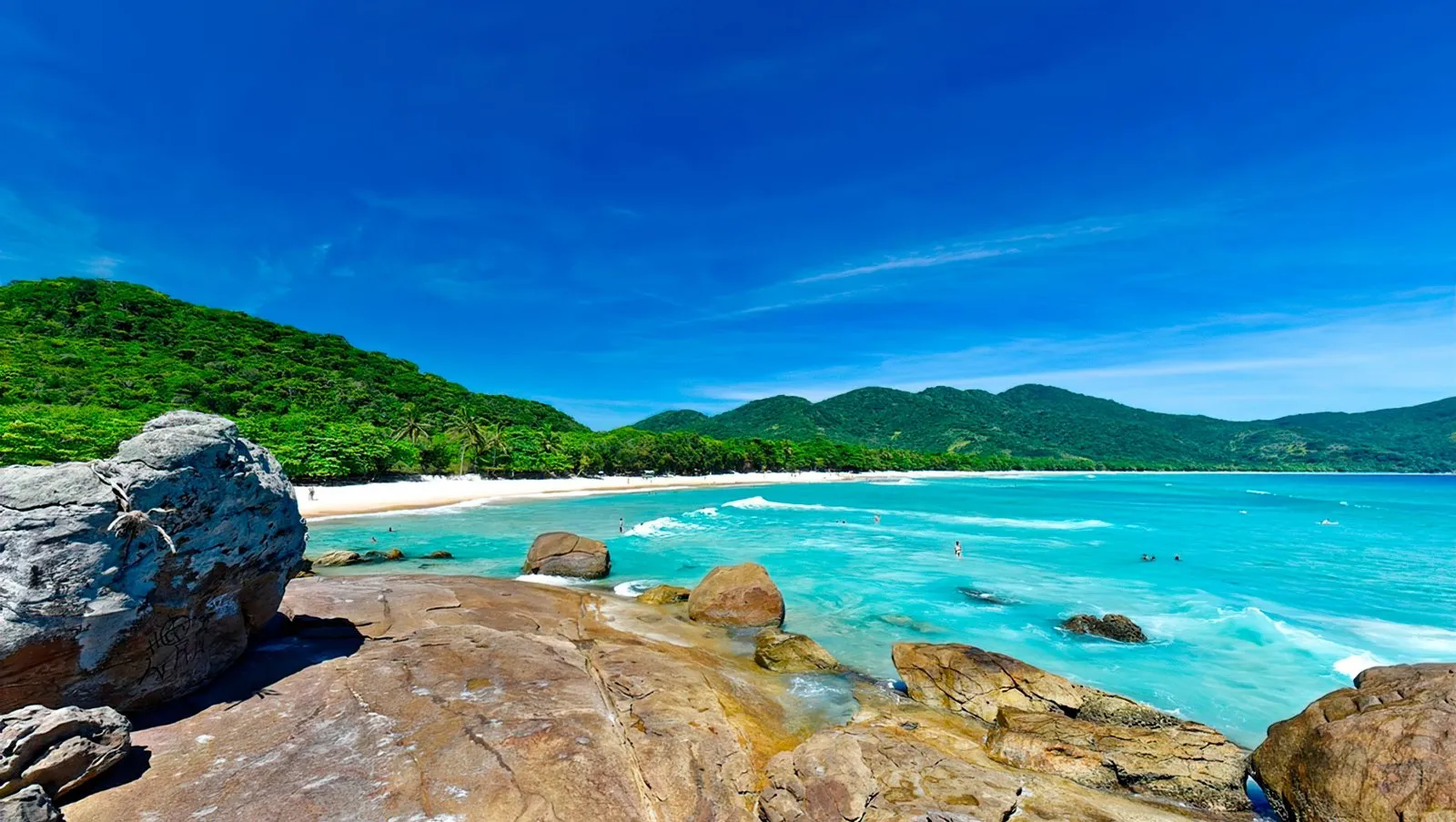
The one everyone comes for — and it lives up to it. Nearly 3 km of fine, pale sand so fine it almost squeaks underfoot, backed by preserved Atlantic forest and lapped by clear, shallow water. It’s regularly listed among the best beaches in Brazil (and the world). There’s gentle surf, which makes it a favourite with beginner surfers, and only a couple of rustic huts selling drinks and snacks — almost no development.
Boats can’t land at Lopes Mendes itself. The usual way is a schooner (escuna) from Abraão to Praia do Pouso (around R$70 round trip) or a faster taxi boat (around R$100 round trip) — see the day-planner below for exact times and one-way fares, then the short T11 trail (~1 km, 30–40 min) over the headland. You can also walk the whole way on T10 + T11. See the full route in our trails guide.
Dois Rios
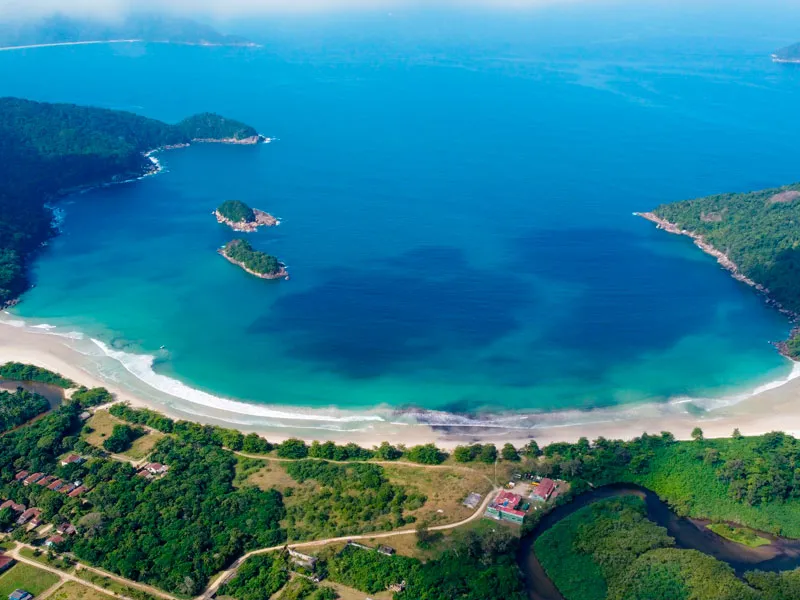
A dramatic beach in a cove between two steep mountains, framed by the two freshwater rivers that give it its name — their water dark but clean and cool. Behind it lies the haunting near-ghost-town of the old maximum-security prison (1904–1994), now a museum and university campus slowly being reclaimed by the forest. Reached on foot via T14 (~7 km) or by boat tour. There’s little infrastructure, so bring water and food. Full walking details are in our trails guide.
Calm water & snorkelling
Lagoa Azul
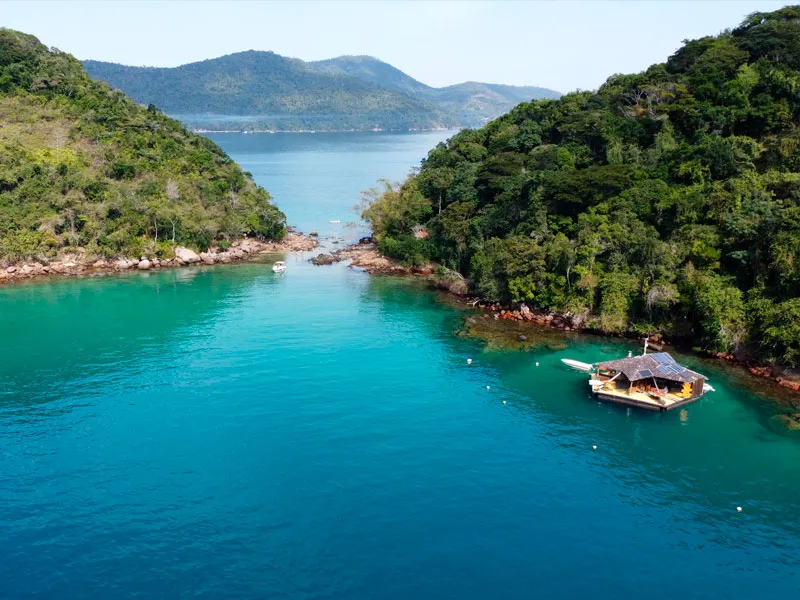
Not a beach but a shallow, turquoise lagoon between islets on the north side of the island, with calm, crystal-clear water and reef fish — the island’s signature snorkelling stop. It’s a fixture on almost every schooner and speedboat tour. Bring (or rent) a mask; the calm water is ideal for first-timers and families.
Lagoa Verde
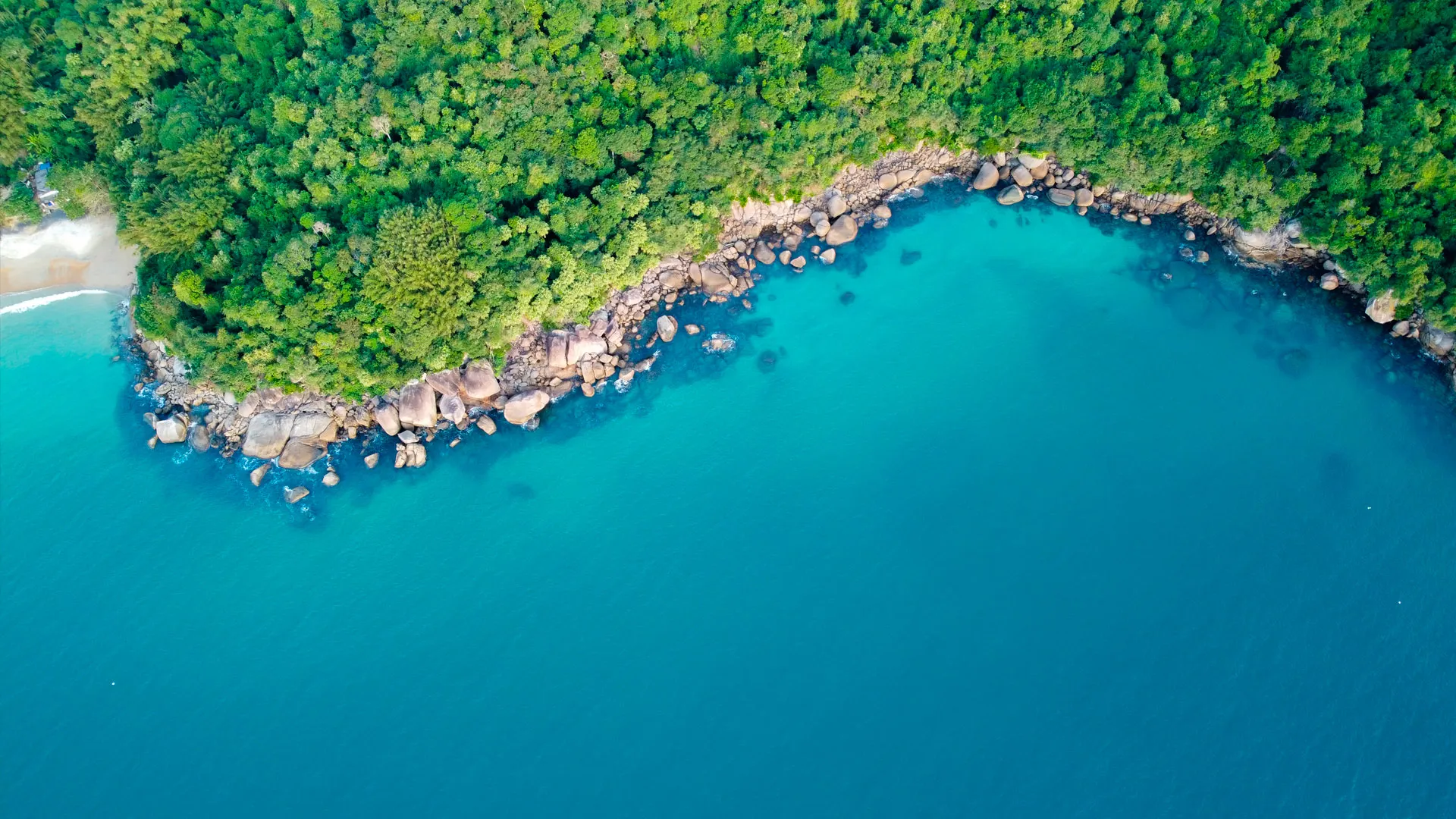
Another sheltered, green-blue snorkelling lagoon, closer to Abraão, with calm water and plenty of fish. Like Lagoa Azul, it’s a standard stop on day-tours and an easy, gentle place to get in the water.
Quieter & remote
Palmas
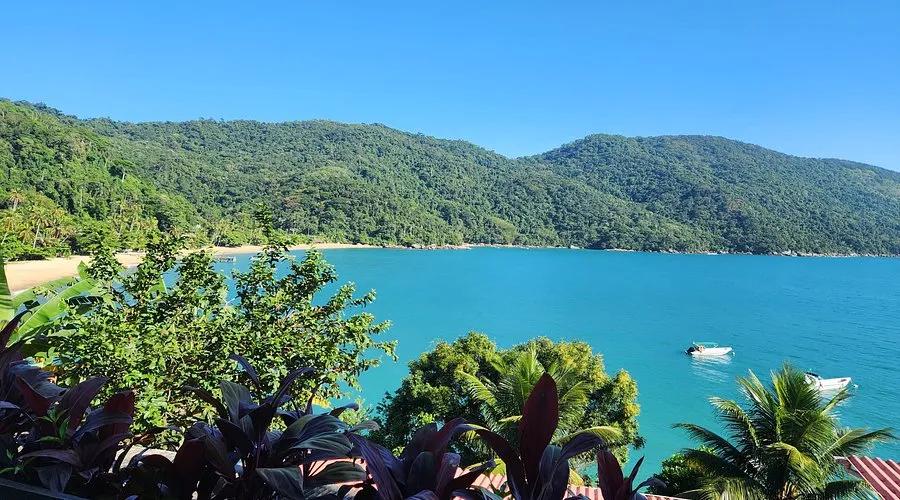
A calm, pretty beach on the T10 trail between Abraão and Pouso — a natural place to pause (and cool off) on the walk to Lopes Mendes.
Caxadaço
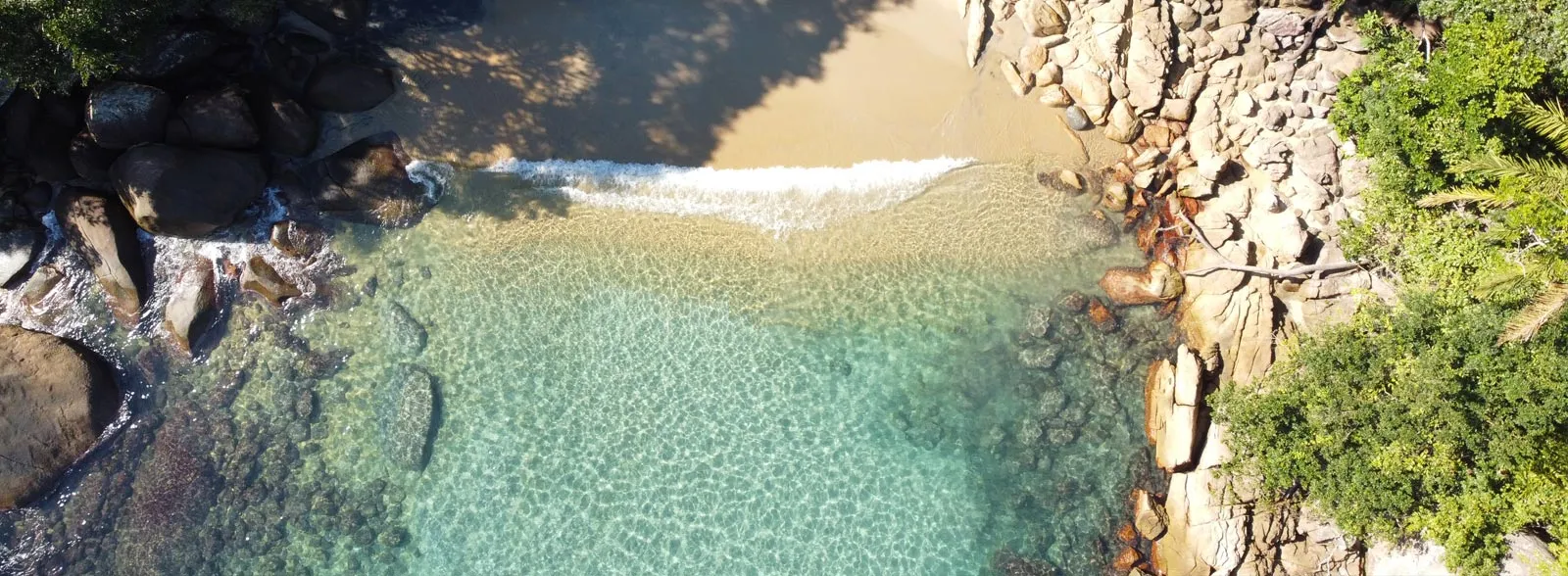
A small, beautiful cove near Dois Rios, reached by trail (T15) or boat. It’s more than a beach: Caxadaço is also a viewpoint (mirante) and a well-known cliff-jumping spot into deep, clear water — with good snorkelling among the rocks.
Aventureiro
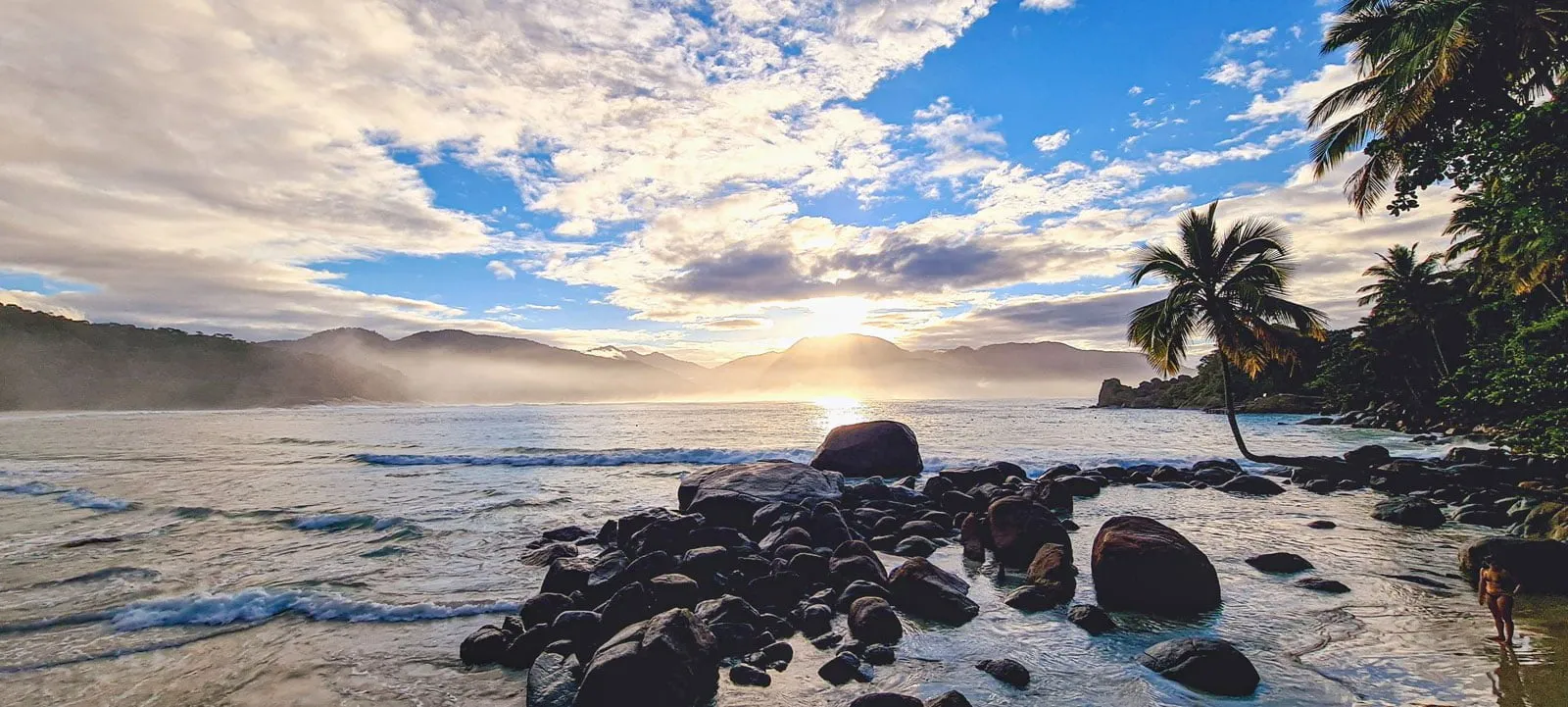
The island’s most famous wild beach, on the exposed south-western side inside the Reserva Biológica da Praia do Sul — remote and far from the rest, nothing like the coves you can reach in ten minutes. It’s a former fishing community famous for the iconic wind-bent palm leaning over the sand and for its big Atlantic swell. Because it sits inside a strict biological reserve, surfing is not allowed and visitor numbers and camping are regulated. You reach it by boat, or on land via trail T9 from Provetá (~4.3 km) — not on foot from Abraão. A short visit needs no permit, but staying more than two hours requires authorization, which is why boat tours pause there for about 1h30. Come for the raw, off-grid feel, not for beach bars.
Parnaioca
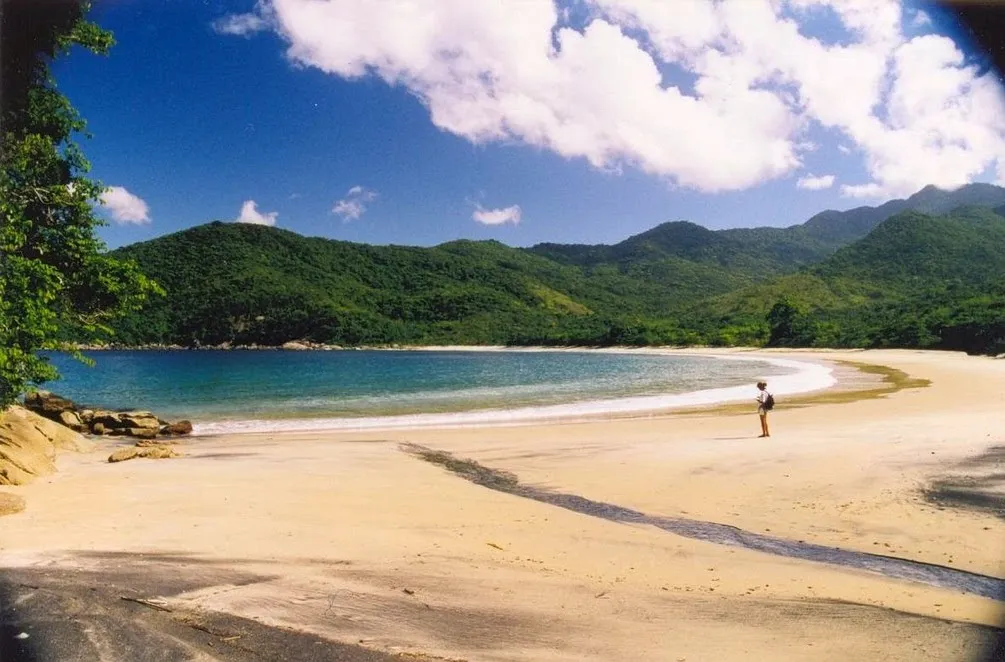
One of the most remote beaches, on the southern coast — a former fishing village reached by a long trail (T16 from Dois Rios) or by boat. Big, wild and almost empty; for travellers who want true solitude. There’s a simple campsite here, so you can pitch a tent and stay the night.
Meros
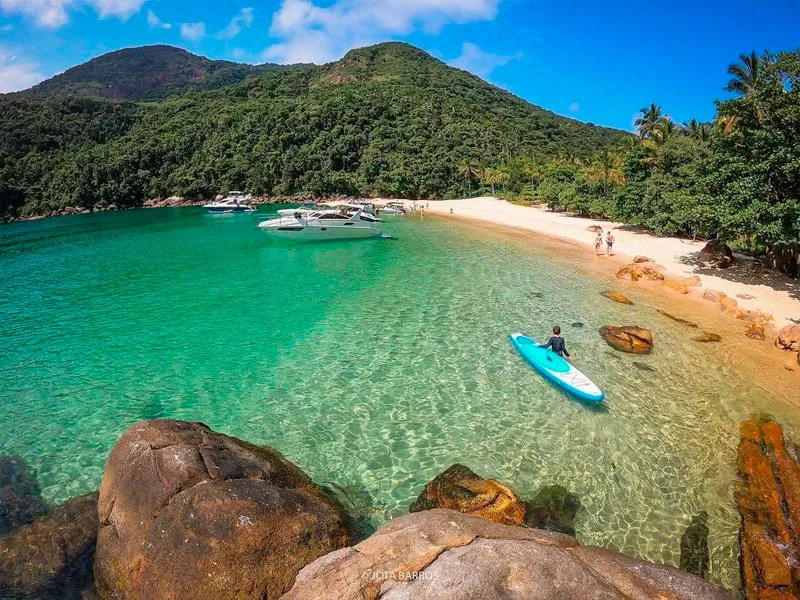
A quiet beach on the western side of the island, near the Provetá/Aventureiro area — peaceful, far from the crowds, and with good snorkelling.
Gruta do Acaiá
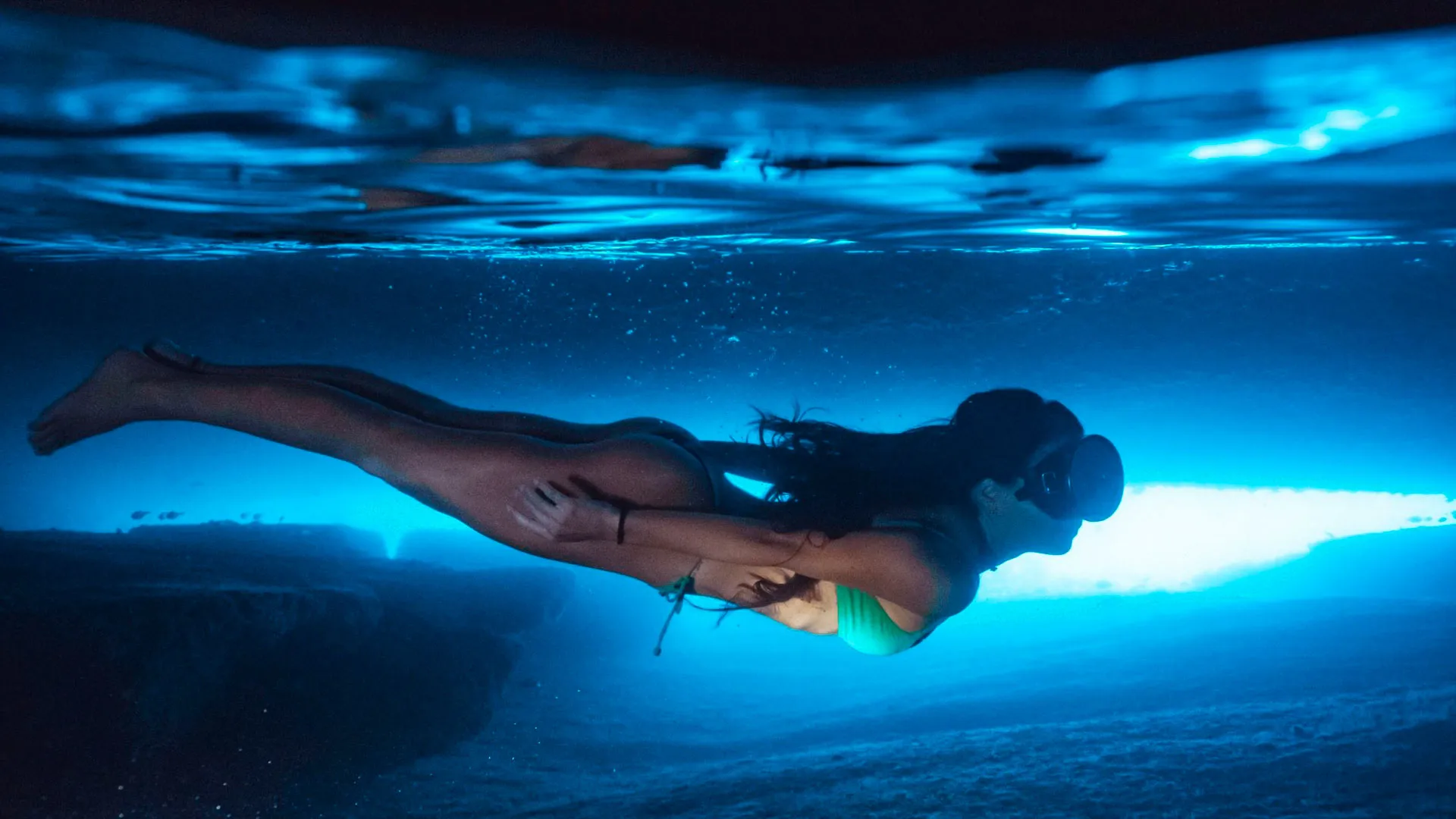
Not a beach but a striking sea cave, half-submerged and reachable only by boat. Its magic is the light: when the sun hits the entrance at the right angle, the water inside glows an electric blue, while the sea echoes off rock walls sculpted over thousands of years. It’s usually visited on a day-tour that also stops at the snorkelling lagoons (Lagoa Azul, Lagoa Verde) and the quiet cove of Grumixama.
Boat tours: the island by sea
Most of Ilha Grande never sees a road. The beaches that stop you mid-sentence — turquoise coves, snorkelling bays where the fish come to you, sea caves that glow — sit on a coastline you can only reach by hull. A boat day here is the closest thing to seeing the island the way the caiçara fishermen always have: slowly, from the water, one bay at a time. If you take just one tour from your stay, this is the day you’ll be showing people photos of for years.
A few of these spots you can also walk to (and for one of them I’d urge you to — more below), but the open-sea south, the calm northern lagoons and the outer islands of the Angra archipelago are boat country. Every tour leaves from the Abraão pier, a couple of minutes from the village.
Before you book. Treat any boat tour as your whole day — they start late morning and are back by late afternoon, so plan only breakfast and dinner around them. Each tour strings together about five stops (roughly four beaches or sights plus one lunch stop, around an hour each). And remember: boats can’t navigate after dark, so nobody returns later than about 5:30 pm. Departure times are fixed (you can’t ask a shared tour to leave earlier or come back later — that’s what private hire is for), so just book a day or two ahead; the good ones fill up.
Open-sea south: the Atlantic beaches (Super Sul, Volta à Ilha)
This is the showstopper side — the wild Atlantic coast, the most sought-after and the prettiest water on the island. If you want the gradient-blue, end-of-the-world beaches, you come south.
Super Sul is the highlight reel of the south in a single day: a quick hello to Lopes Mendes (the iconic beach), a snorkel at Ilha de Jorge Grego (a snorkelling islet), the clifftop Caxadaço viewpoint — where the colour gradient is honestly better than the little beach below it — and a lunch stop at the historic village of Vila de Dois Rios. Stops: Lopes Mendes · Jorge Grego · Caxadaço · Dois Rios (lunch).
A word on Dois Rios by boat. Reaching it by boat means transferring to a local village boat out in open sea, and the tiny kitchen wasn’t built for a tour group — waits can eat into your stop. I’d walk to Dois Rios rather than rush it on the boat — see the trails guide. The village, its rivers and the old prison museum deserve unhurried hours, not a hurried lunch.
Volta à Ilha is the grand tour — the full loop right around the island, and the longest day on the water. You feel the sheer scale and wildness of the place. It links Caxadaço (clifftop viewpoint) with two of the south’s finest beaches, Parnaioca (spectacular turquoise water) and Aventureiro (home of the famously 90°-leaning palm older travellers will recognise from an old Windows wallpaper), then finishes the marine half at Meros (a snorkelling bay where fishermen rest their boats, so fish gather close to shore). The west-shore marine life is the quiet star of this one. Stops: Caxadaço · Parnaioca · Aventureiro · Meros · lunch.
Lunch — bring your own. On nearly every tour, lunch is not included, and the lunch spot is a captive audience picked by the sailor — no Booking or Google reviews keeping it honest — so value and quality can be uneven. My advice: pack your own sandwiches, fruit, snacks and drinks, and don’t be shy about it. If you do eat out, mind the basics — this is Brazil, the tap water isn’t drinkable, and I’d be wary of shrimp or ice. Nobody wants to spend the back half of their holiday unwell.
The calm north: the two lagoons (Meia Volta, Gruta do Acaiá)
The north’s glory is its sheltered water. The two lagoons — Lagoa Azul, prized for its transparency, and Lagoa Verde, where turtles are almost always about and the water colour shifts dramatically — are the calmest, clearest snorkelling on the island, perfect for families and nervous swimmers. (A note of honesty on Lagoa Azul: recent construction nearby has begun to disturb the natural water flow.)
Meia Volta is the gentle half-loop — an easy, pretty introduction to the calm side, taking in both lagoons plus Praia do Amor and Praia da Feiticeira (the one you can also reach on foot). A lovely first day on the water if the open sea feels like a lot. Stops: Lagoa Azul · Lagoa Verde · Praia do Amor · Praia da Feiticeira.
Gruta do Acaiá is the upgrade — and the most memorable thing you can do on the calm side, as long as you’re not claustrophobic. The Gruta do Acaiá itself is a sea cave with luminescent water: you enter the rock down a roughly 50° incline (a slope, not a temperature), have to crawl, and the narrowest point is just 80 cm wide. The reward is dazzling — water that glows blue or green, sometimes phosphorescent, from light refracting inside the fissure. The tour pairs it with both lagoons and the tiny, picturesque cove of Grumixama (a tiny cove). Stops: Gruta do Acaiá · Lagoa Verde · Lagoa Azul · Grumixama. (Some operators run an earlier version — see the table.)
Tip — the early start is worth chasing. The earlier version of the Gruta tour gets you to the two westernmost spots (the cave and Lagoa Verde) before the crowds, and it makes a perfect checkout-day plan: if your pousada offers a late checkout, you can be back by mid-afternoon for a hot shower and clean towel before your evening transfer.
The Angra islands: the celebrity archipelago (Ilhas Paradisíacas)
These are the islands that flood your feed — the gradient-turquoise, white-sand, did-you-Photoshop-that shots. They’re genuinely paradisiacal, and they’re not actually on Ilha Grande at all: they sit out in the Angra dos Reis bay, around Gipóia, very close to Angra. The good news is you don’t have to chase them one by one — a single tour, the Ilhas Paradisíacas, packages the whole archipelago, about an hour at each stop, and still leaves from the Abraão pier like everything else.
☀️ Sunny days only — no compromise here. More than any other tour, this one lives and dies by the light. Give it a full, cloudless day and you get the unforgettable photos and water that doesn’t look real. Under cloud or rain the colours collapse and it simply isn’t worth doing.
Cataguás — wade between four islets. This is where I’d start your imagination. It’s not one island but four little islets, and the magic is this: arrive early, before the tide rises, and you can walk between them with the water only up to your torso — no swimming from one to the next, just wading through ultra-crystalline turquoise over fine white sand. It’s spectacular, and honestly one of my favourite beaches anywhere around here.
Praia do Dentista (Ilha da Gipóia) — the emerald showpiece. This is the one most visitors crown the most beautiful of all the paradise islands, and I won’t argue. The water is an almost-emerald green, very distinctive, unlike anything on the rest of the route — warm, clear, the kind you wade into and don’t want to leave. It’s a long beach and worth walking end to end: the sand is medium-to-coarse and a touch yellowish in the middle, but out at the dry tips it turns whitish, reason enough to walk all the way to the ends.
Care for what isn’t yours — as if it were your own. Dentista’s signature used to be a centenarian palm that grew leaning out almost horizontal over the sand before rising up — the favourite postcard of every influencer and every couple who came through. A few years ago some youngsters climbed and jumped on it, and it broke. It’s gone now. But what stayed with me wasn’t the loss — it was watching the locals, people born and raised on these waters, in tears, all of them together lifting that palm, splinting it, trying to save it. A palm tree, yes. But it was theirs: the childhood equivalent of a treasured toy, where they’d strung hammocks, climbed, fallen and grown up. It moved me to the bone and pulled me closer to this community. So here’s the one thing I’d ask of you: care for other people’s heritage as if it were your own — because when everyone cares for it, it stops belonging to someone and starts belonging to all of us.
Botinas — best snorkelling, no beach. Two little islets, vaguely boot-shaped, hence the name — but really they’re islands without a beach: picture two rocks each crowned with what looks like a bouquet of palm trees. The reason you stop is the water between them: super-crystalline, warm, with schools of fish in every colour. One of the loveliest snorkelling spots on the whole route.
The honest catch at Botinas: lovely fish, busy water. Just metres east and west of where they drop you to swim, there’s heavy speedboat traffic running between Cataguás, Flechas and Gipóia. So the sea here is never the glassy, mirror-calm you get at Lagoa Azul or Lagoa Verde — there’s a constant, almost artificial swell rolling off the boat wakes. Now you know before you jump in.
Ilha da Piedade — the symbolic one, and the least pretty. A small islet almost joined to Ilha da Gipóia by a sandbar. It’s pretty, it has a little chapel, and on a very sunny day it seems to “divide the waters” — a shade bluer on one side, greener on the other, though it’s exactly the same water. I’ll be straight with you: it’s the least beautiful of the four stops, not dazzling at all. What it carries is symbolic weight. For 30 years this was the famous “Ilha de Caras,” held under a long concession by Caras, the celebrity magazine read across Latin America — Argentina, Brazil and beyond. The stars all posed here. If you grew up with Caras, that means a great deal; if you didn’t, it’ll mean very little, and that’s perfectly fine.
Want a real lunch stop? Ask for the Flechas version. Some tours — not all — drop Piedade and put Praia de Flechas in its place, and for foreign visitors that’s often the nicer call, because Flechas is a stop where you can actually eat. It’s very pretty, has a restaurant, the water is greener and quite calm, and it feels a lot like Abraãozinho — just more deserted. If a fixed lunch stop matters more to you than a celebrity footnote, ask for it when you book.
These are the Angra islands worth seeing, and the lucky part is that they all arrive in this one tour. Pick your sunny day and let it run.
Alternative tours (Jerónimo, Caipirinha, Passeio do Índio, private hire)
Not every day on the water has to be the standard speedboat circuit. A few have real character of their own.
Jerónimo’s tour is the relaxed, slightly hippie one, run in a traditional traineira with a trilingual guide. You walk up to see Freguesia de Santana (a historic hamlet), drift along the beautiful beach at Freguesia de Fora, spend the afternoon at Lagoa Azul, and lunch at Saco do Céu with kayak, snorkel and SUP thrown in. Crucially, it’s one of the very few tours that includes lunch — easy to arrange and well worth it.
The Caipirinha tour is the party boat — a “Jack Sparrow” host, free caipirinhas all round, sailing in a schooner (escuna) or galleon. Frequent in high season, lunch on board optional (paid separately or pre-bought).
Passeio do Índio runs in a Canadian canoe — by night to see the luminescent plankton, by day on personalised trips. A lovely, low-key alternative, and worth it.
Private boat hire is the freedom option: up to 10 passengers (eight is the comfortable number to split the cost), fully personalised — two to four hours per spot instead of the rushed hour, an earlier start and a slightly later finish. The one hard rule still applies: no return after dark, around 5:30 pm.
At a glance: tours, routes and rough prices
Prices below are rough, per person and fluctuate with the season — treat them as a guide, not a quote. One thing that surprises people: Super Sul costs more than the longer Volta à Ilha — and it’s not a typo. It’s the one tour that crosses open sea to Ilha de Jorge Grego, which takes a bigger, more powerful (and pricier) boat than the others use. Where a cell says ask when booking, the detail genuinely varies and is best confirmed at the time.
| Tour | Route in a phrase | Hours | ~Price/person | Lunch |
|---|---|---|---|---|
| Super Sul (lancha) | South Atlantic highlights | 10:30–17:00 | ~R$300 | Not included |
| Volta à Ilha (lancha) | Full loop around the island | 09:30–17:30 (longest, ~8 h) | ~R$200 | Not included |
| Meia Volta (lancha) | Gentle half-loop, both lagoons | 10:30–16:30 (~6 h) | ~R$150 | Not included |
| Gruta do Acaiá (lancha) | Sea cave + the two lagoons | 10:30–17:30 (some 09:00–16:00, ~7 h) | ~R$200 | Not included |
| Ilhas Paradisíacas (lancha) | Angra/Gipoia islands | 10:30–17:30 | ~R$170–180 | Not included |
| Jerónimo (traineira) | Freguesias, Lagoa Azul, Saco do Céu | 09:30, ~7–8 h (flexible) | ~R$250 | Included |
| Caipirinha (escuna/galleon) | Party cruise, free caipirinha | 11:30–17:30 | Ask when booking | Optional (paid/pre-bought) |
| Passeio do Índio (Canadian canoe) | Plankton by night, custom by day | ~5–6 am start (flexible) | Ask when booking | Ask when booking |
| Private hire (boat to suit) | Fully personalised, up to 10 pax | Custom (no return after ~5:30 pm) | ~R$1,500/trip (~R$1,400–2,000) | Ask when booking |
I haven’t named operators here on purpose — boats and prices change hands often here. Any of the agencies along the Abraão waterfront sells these same tours; the table above tells you what to expect, and for the full-day tours, insist on a lancha.
CF or lancha? Choosing your boat
Short version: a short hop in a taxi-boat (a “CF”) is fine — but for a proper full-day tour, especially the Volta à Ilha, pay a little more and go in a bigger lancha. When you book, ask what kind of boat it is and have them confirm it. It sounds fussy; it isn’t — it’s the difference you feel in your stomach by mid-afternoon.
| CF (taxi-boats) | Lancha (the bigger kind) | |
|---|---|---|
| Hull | Long and thin, “like an anchovy” | More surface, more buoyancy |
| Feel | Nimble, but moves with every wave | Noticeably more stable and safer |
| Engine | A single motor | Two motors, or one much larger |
| Cost | Cheaper | A bit more |
| Best for | Short hops | A full tour / Volta à Ilha |
A CF is the local name for a hull type. Technically a CF is a lancha (a launch), but its long, thin hull loses buoyancy, so it’s agile and runs on a single motor — and it rocks with every passing wave. All taxi-boats are CFs. A bigger lancha has more surface and buoyancy, so it’s steadier and safer; its maintenance is regulated and kept up to date, and it costs a little more.
Why it matters. On a tour where you float and linger — say, bobbing at Lagoa Azul — a CF rocks with every wave and can quietly make you queasy, while a bigger lancha just sits there steady while you snorkel.
An honest balance. None of this means avoid taxi-boats — they’re all CFs, and each kind of boat has its own use and purpose. A short hop is exactly what a CF is for. What you can’t sensibly do in a taxi-boat is the full Volta à Ilha; an experienced boatman could, but as a tourist you shouldn’t. So the simple tip: for a real tour, pay a little more and go in a lancha, booked through a known, physical agency.
How many days do you need?
Five to seven days is ideal — but whatever your dates, here’s how to nail it.
Only 2–3 days? Your quick plan
Short trip? You can still hit the best of the island. Here’s the no-fuss version:
- Day 1 — Lopes Mendes. The one beach you cannot skip (how-to below).
- Day 2 — A boat tour. If the day’s grey, make it the Volta à Ilha (the full island loop). If it’s bright, save the loop and pick a sunnier tour instead.
- Day 3 (if you get it) — the Historic Circuit (trail T1). Flat, easy, and good for everyone.
Four days? Add a second boat tour — Gruta do Acaiá (the sea-cave tour) or Ilhas Paradisíacas (the Angra islands). More on both below.
The one must-do: Lopes Mendes
Whatever else your trip includes, see Lopes Mendes. There are two ways in: walk it, or take a boat and walk only the last bit.
- On foot — trails T10 + T11 (the Lopes Mendes trails), 2h30–3h15 one way depending on your pace — a real, fairly demanding forest hike, not a stroll; the return leg is the slower, harder part.
By boat. Two services cross from Abraão to the Lopes Mendes side: the escuna (a schooner — scheduled and cheaper) and the taxi-boat (faster). Either way, from where you land it’s a short walk to Praia do Pouso, then trail T11/T12 (~1 km) over to the beach.
| Boat | Leaves from | Departs | Crossing | Drops you at | One-way | Round trip |
|---|---|---|---|---|---|---|
| Escuna | Abraão main pier (cais principal) | 10:30 all year (+9:30 & 11:30 high season) | ~50 min | Praia dos Mangues, ~50 m from Pouso | R$35 | R$70 |
| Taxi-boat | Abraão | from ~10:30 (see note) | ~15 min | Praia do Pouso | R$60 | R$100 |
The escuna return leaves from Mangues (the beach right next to Pouso — you walk back over) at 3:30 pm all year (+4:30 & 5:30 in high season, for the long summer evenings).
Book it right — and what to avoid
- Go in the morning. It isn’t worth heading over after noon — and at midday Brazil stops for lunch, so the waterfront empties out.
- Book through the official channel only: the escuna at its ticket desk, or the taxi-boat through the official Central de Táxi-Boat. The official taxi-boats are yellow-and-black and give you a wristband so they know to collect you for the return.
- Never grab a random taxi-boat off the waterfront. You risk paying for a round trip and simply never being picked up — then paying again to get back. It really happens, whatever locals tell you.
- Your taxi-boat return time is fixed when you buy (3, 4 or 5 pm, picked up back at Praia do Pouso) — stick to it. They plan their boats around it; turn up for a later one and if it’s full, they won’t take you.
A note on taxi-boat timing: they advertise a departure every 30 minutes from 9 am, but each boat needs a minimum group before it goes — so realistically count on ~10:30 for your first dependable crossing, then every 30 minutes until noon.
Weather: Lopes Mendes is lovely even on a cloudy day — don’t waste a grey morning waiting for sun. Just don’t take the walking route in the rain or the day after heavy rain; take the boat instead.
Let the sky decide your plan
The smartest way to spend your days here is to let the weather choose the order. Check the sky and the forecast the night before — if tomorrow looks overcast, make it your Volta à Ilha day.
-
A grey / overcast day → Volta à Ilha (the full island loop). The all-rounder: a full day on the water, beautiful stops all the way round, and you come home tired, tanned and happy. About 8 hours (09:30–17:30), ~R$200.
-
Your second boat day → pick by what you want.
- Want adventure → Gruta do Acaiá (the sea-cave tour). Two lagoons where you’ll tire of counting fish, plus a luminescent cave you won’t find anywhere else. About 7 hours, ~R$200.
- Want postcard-perfect, Caribbean-like islands → Ilhas Paradisíacas (the Angra islands). Calm, gorgeous water, a great snorkel stop at Botinas, and the headline stop, Ilha da Piedade — the famous “Ilha de Caras.” 10:30–17:30, ~R$170–180.
-
A spare or extra day → take it easy on land.
- The Historic Circuit (trail T1) (the flat historic loop) is excellent for everyone — including travellers who are tired, older, or want a gentler day — because it’s flat and easy.
- Add the Feiticeira waterfall (trail T2) (the Feiticeira climb) if you’re up for a bit more effort; it’s well worth it.
- Or head to Abraãozinho and/or Crena — reachable on foot or by boat.
Full details for these walks and tours are in the walk and boat-tour sections above.
Why 5–7 days?
You can do the highlights in two or three days, but a few extra days turn a good trip into a great one:
- Weather isn’t guaranteed. Sun comes and goes here, so the more days you have, the more good-weather days you’ll catch — and the easier it is to let the sky decide your plan.
- There’s far more to do than you’d think. Beaches, trails and boat tours stack up fast; spare days rarely go to waste.
- It spreads your travel cost. Getting here isn’t cheap (the trip in and out, plus the flat R$50 Taxa Viva Angra — the same whether you stay 2 days or 30), and those are fixed costs. Like a long-haul flight, the longer you stay, the more worthwhile each day becomes — three days barely repays the effort; a week or two truly earns it. The day-to-day, food included, is the cheap part.
The main beaches & communities, one by one
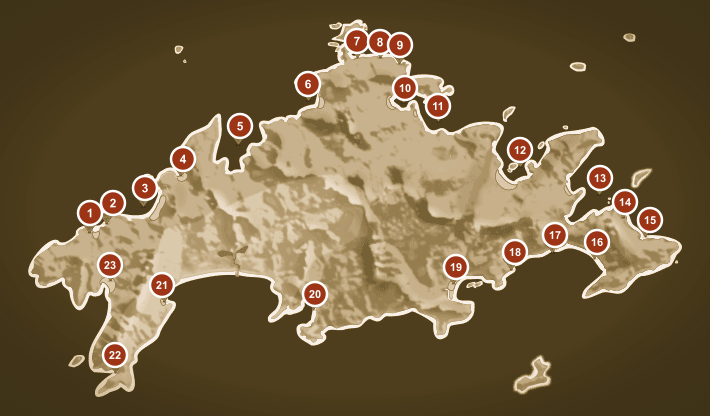
Ilha Grande has around 113 beaches — far more than anyone could list. These are 23 of the main ones (and the fishing communities), matching the numbered points on the map above, from the calm northern and western coves to the wild Atlantic beaches of the east.
Villages & communities
- 1
Praia Vermelha
A caiçara fishing village (~150 inhabitants) on the island's most preserved side, near Araçatiba; calm greenish water, a few pousadas and restaurants. Reached by boat from Angra (~45 min) or on foot. A good diving spot.
- 3
Enseada de Araçatiba
A fishing village (~370 inhabitants) on a wide cove with several beaches linked by trails and clear water for snorkelling. Reached only by boat from Angra (~25 min by speedboat). The island's second tourist hub after Abraão.
- 4
Praia Longa
A fishing and mussel-farming village, with the São Pedro church facing the pier and the Cachoeira da Longa waterfall nearby. Reached by boat from Angra (~25 min) or on foot from Bananal or Sítio Forte. A quiet hamlet with little infrastructure.
- 5
Enseada de Sítio Forte
A central cove of calm water with several small beaches (Tapera, Ubatubinha, Marinheiro…) and a rocky cliff wall. A caiçara village living from fishing and oyster and mussel farming. Reached only by boat. Wreck diving on the Pinguino.
- 6
Enseada do Bananal
A caiçara village on the north coast (~370 inhabitants) with a Japanese heritage — old sardine canneries — and several calm beaches for diving. Reached by boat or schooner from Angra, and by trail. A quiet hamlet.
- 10
Saco do Céu
A fishing village in a well-sheltered northern cove, surrounded by Atlantic Forest and mangroves, with calm water. Reached by boat from Abraão or via trail T02. Rustic, with pousadas and restaurants serving good food.
- 11
Enseada das Estrelas
A northern cove with a small community and semi-deserted beaches (Feiticeira, Camiranga, Perequê…), clear water with starfish. Reached by boat or on foot. Access to the Feiticeira waterfall.
- 12
Enseada do Abraão (Vila do Abraão)
The largest cove and the main town: the island's gateway, with a horseshoe beach, shops, pousadas and a pier. Reached only by boat from the mainland, and there are no cars. The trails and boat trips all start here.
- 13
Enseada de Palmas
One of the oldest caiçara villages, very sparsely populated and rustic (no mains electricity), with palm trees, campsites and bars. Reached on foot via trail T10 from Abraão (~4.7 km, ~1h40) or by boat. The closest access point to Lopes Mendes.
- 19
Dois Rios
A historic village with an open-sea beach, site of the former Cândido Mendes prison (ruins and a museum) and a UERJ university centre, ~150 inhabitants; two rivers with waterfalls and surf. Reached on foot via trail T14 (~7,2 km, ~2h30) or by boat. No overnight stays allowed.
- 23
Provetá
A fishing village at the western tip, the island's second-largest community (~1,500 inhabitants), with a sheltered beach of green water and little tourism. Reached by boat from Angra (~2 h) or on foot from Aventureiro or Araçatiba. Diving at Ilha dos Meros.
Semi-deserted & deserted beaches
- 2
Itaguaçu
A semi-deserted beach and cove in the south, near Praia Vermelha and Araçatiba, home to a single family (with a pousada); calm water sheltered by rocks, ideal for snorkelling. Reached by boat or on foot from Araçatiba. Almost solitary.
- 7
Freguesia de Santana
A historic fishing community in the north, cradle of the island's first settlement, today home to ~50 residents and the colonial Santana church (1843). A calm beach, a regular stop for the schooners.
- 8
Japariz
A north-coast beach with a small caiçara community and waterfront restaurants, calm clear water and pale sand. Reached by boat or schooner (a lunch stop) or on foot from Abraão. Very busy in season.
- 9
Funil
A tiny, wild beach (~10 m) hidden in a corridor of vegetation next to Japariz, with lake-still water. Reached by boat (5 min from Japariz) or on foot. An almost deserted corner, with no infrastructure.
- 14
Jurubá
A deserted, rocky beach (~25 m) on the east coast, between Palmas and the Castelhanos lighthouse, ringed by forest and calm water. Reached on foot via trail T12 from Pouso (~30 min) or by boat. Isolated and almost untouched.
- 15
Castelhanos
A rocky, semi-deserted beach at the eastern tip, beside the historic Castelhanos lighthouse, with a single resident family and no services. Reached by boat or via trail T12 from Pouso (~1 h). Isolated — a day-visit spot.
- 16
Lopes Mendes
A long beach of almost 3 km of white sand and crystal-clear water on the east coast, uninhabited and protected, famous for its beauty and its surf. Reached by boat to Pouso plus a ~1 km trail (or the full trail from Abraão).
- 17
Santo Antônio
A small fine-sand beach near Lopes Mendes, with large rocks, a freshwater stream and a view of Ilha Jorge Grego; good for snorkelling and surfing. Reached only on foot (a short trail from Pouso). Almost always semi-deserted.
- 18
Caxadaço
A wild, almost deserted cove (~15–20 m) between Dois Rios and Lopes Mendes, with a natural rock pool, crystal-clear water and good snorkelling. Reached by boat (usually part of the "Volta à Ilha" island tour) or via the demanding trail T15 from Dois Rios. It has a viewpoint and a cliff-jumping spot.
- 20
Parnaioca
An isolated Atlantic beach of almost 1 km, with coarse yellowish sand and open sea; once the island's largest village (>1,000 inhabitants), today an almost deserted hamlet with ruins and a chapel, no electricity or signal. Reached on foot via trail T16 from Dois Rios (~3 h) or by boat. There is a campsite for overnight stays.
- 21
Aventureiro
A semi-isolated, protected beach at the southern tip, inside a sustainable-development reserve: a caiçara village with rustic campsites (no hotels, almost no electricity or signal) and open sea for surfers. Reached only by boat (1–3 h) or via trail T9 from Provetá (~4,3 km). You need nothing for a short visit, but staying more than 2 hours requires an authorization (which is why boat tours pause about 1h30).
- 22
Meros (Praia dos Meros)
A small, isolated beach at the south-western tip, reachable only by sea (by speedboat or schooner, on the "Volta à Ilha" tour or from Provetá/Araçatiba). Semi-deserted, with clear water and very white sand, and excellent snorkelling.
The 5 islands of Angra (a boat trip from Abraão)
These are not on Ilha Grande itself, but in the Angra dos Reis bay nearby — five paradise islands and sandbars usually strung together on a boat day-trip from Vila do Abraão.
- A
Dentista (Ilha da Gipóia)
A beach of calm, crystal-clear water (officially Jurubaíba), on Ilha da Gipóia; reached only by boat from Angra (~30 min). A popular anchorage for speedboats and sailboats, a social atmosphere and floating bars; quieter on weekdays.
- B
Cataguás
A small island of white sand and Caribbean-coloured water off Angra, with no services and surrounded by fish, ideal for snorkelling. Reached only by boat; a regular stop on the tours.
- C
Botinas
Two twin rocky islets (shaped like boots) in the bay, with no beach; reached only by boat. Between the two islands lies a crystal-clear natural pool, aquarium-like, very popular for snorkelling and diving.
- D
Flechas (Ilha da Gipóia)
A broad sandy beach on Ilha da Gipóia, reachable only by boat (~15–30 min from Angra). The left side is preserved and quiet; the right has restaurants and kiosks. Blue-green water; it gets lively at weekends.
- E
Piedade (Ilha da Gipóia)
A small cove of calm, clear water on Ilha da Gipóia, famous for its little chapel (Igrejinha da Piedade) beside a strip of sand. Reached only by boat; a stop on the tour. Idyllic, ideal for families.